A customer slips on the still-wet tiles at the entrance. A colleague loses her balance coming down a stepladder in the stockroom, at 6 a.m., alone. Neither of these scenes shows up in a shrinkage report. Yet they weigh heavily on the life of a store. In early November, rain soaks store entrances across much of the northern hemisphere and stockrooms fill up ahead of the holidays: the risk rises precisely when teams have the least time.
In most retail chains, falls and theft belong to two separate worlds, with separate budgets and tools, and rarely the same manager. What if the camera network, the app and the response protocol served both, loss prevention and the safety of people alike?
Falls in stores and stockrooms: an underestimated daily risk
Public health data give an idea of the scale. According to the World Health Organization fact sheet on falls, falls caused around 842,000 deaths worldwide in 2023 and remain the second leading cause of unintentional injury death, behind road traffic accidents. The WHO points out that most falls are not fatal: these figures therefore leave out fractures, sick leave and customers who never come back.
Retail pays its share. In the United Kingdom, the health and safety authority states that slips and trips remain the leading cause of major injury in retail. The typical scenario is mundane: a freshly washed floor left wet, a spilled liquid not wiped up fast enough. At European level, the agency for safety and health at work presents slips, trips and falls as the leading cause of accidents, across all sectors, and as a major cause of absences of more than three days.
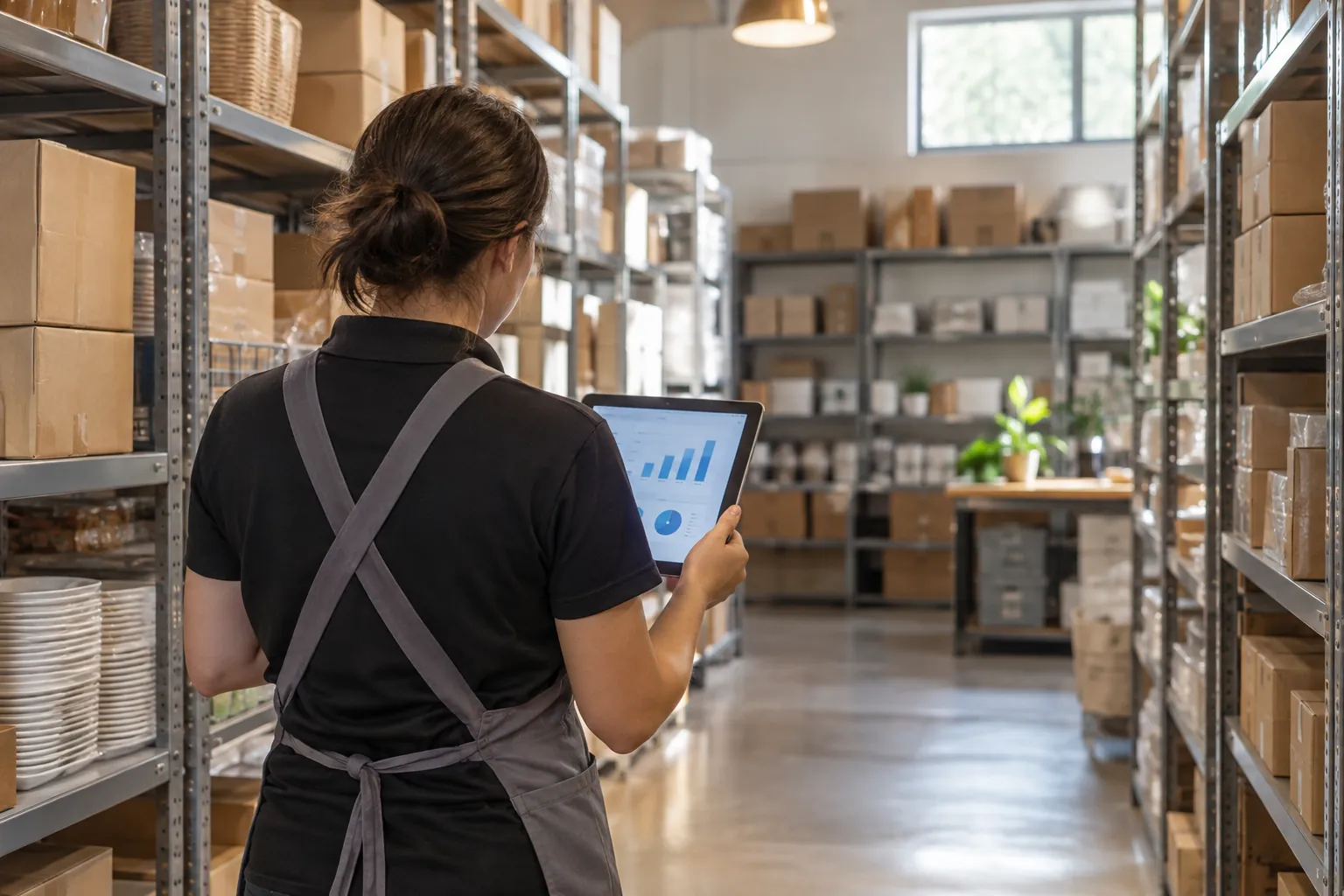
On the ground, everyone knows the black spots: the entrance on rainy days, condensation at the foot of the refrigerated units in the fresh aisle, the areas around the checkouts, aisles cluttered with roll cages during restocking. The stockroom has its own hazards, with boxes on the floor, pallet trucks, stepladders and lighting that is often less well maintained than on the sales floor. And people often work there alone, at opening and at closing.
What a fall alert changes, and what it does not
The principle is simple. Video analysis detects a loss of verticality (a person suddenly going from standing to lying on the floor) and sends a clip to the team. The alert does not replace cleaning, signage or training, and it does not see the puddle before someone slips on it. It comes into play after the fact, to reduce the time a person stays on the floor without anyone knowing.
That delay matters a great deal. The WHO notes that fall prevention also depends on a quick and effective response after the fall: first aid, treatment of injuries, referral to care. In a crowded aisle on a Saturday afternoon, a customer who falls is surrounded within seconds. In a stockroom at dawn, or in an empty aisle an hour before closing, several minutes can pass before anyone arrives. That is where the alert truly proves its worth, and where the employer's duty of care toward its teams becomes very concrete.
To see how this technology is used outside retail, read our article on AI fall detection in stores, hospitals and warehouses.
One system for several types of detection
The real challenge lies less in the technology than in the organization. If the fall alert arrives in the same app as the alerts related to unknown shrinkage, the store has only one process to maintain. The same existing camera network can then cover:
- at-risk gestures related to theft, for example an item slipped into a pocket or a personal bag;
- the opening of packaging and unpacking in the aisle;
- consumption in store before reaching the checkout: a drink consumed in the aisle, an opened packet of biscuits;
- falls, on the sales floor as well as in the stockroom, as long as a camera covers the area.
For the team, the difference is quickly apparent. You maintain and manage a single fleet of cameras, install a single app on devices, and one training session is enough. The reflex never changes: the device vibrates, you watch the clip, you decide. With Oxania, for example, the real-time video alert arrives in under 10 seconds on a mobile, tablet or computer, with a progressive zoom on the point of interest. Detection runs locally, on a GPU installed in the store. The alert, zoom and dashboard features remain the same whatever the type of event. The technology detects, the team decides what happens next.
A shared response protocol with clear priorities
A single system is only as good as the clarity of the response. The danger is that a fall gets lost among shrinkage alerts. Hence a basic rule, to be repeated at every briefing if necessary: people come before merchandise. The framework below can be adapted to each store:
- Receipt: the alert arrives on the devices of the people assigned to the shift, with a short video clip.
- Assessment: fall, at-risk gesture, opened packaging or false alert. The clip almost always makes it possible to decide within a few seconds.
- Prioritization: a fall takes precedence over any other alert in progress. The nearest team member goes, and a colleague takes over their post if needed.
- Appropriate response: for a fall, give assistance and call emergency services depending on severity and local guidelines. For an at-risk gesture, walking over to the aisle and offering the customer help is often enough.
- Closure: the alert is marked as confirmed or not relevant, with a note on the follow-up given.
- Feedback review: each week, a few minutes to review the alerts and adjust the guidelines.
This protocol fits easily with the work of security officers, where the store employs them. We go into this point in our article on how AI and security officers complement each other.
Why teams buy in more easily
Presented as a simple anti-theft tool, a video system quickly worries employees: fear of being evaluated, a feeling of being constantly watched. The fall alert shifts the conversation. The tool also protects the person tidying the stockroom alone at opening, and this can be explained in two minutes at the morning briefing.
A few principles, valid everywhere, help build trust. Explain what the tool analyzes (gestures, never the identity of individuals) and what it does not do. Inform the people filmed clearly, customers and employees alike, in line with local regulations, and consult staff representatives where the law requires it, before going live. Restrict access to clips to those who genuinely need it. Sometimes it then takes just one fall handled quickly for perceptions to shift: the tool stops being "management's camera" and becomes a shared safety net.
Measuring benefits shared between loss prevention and safety
A single system has one last advantage: its data can be read together. The same dashboards display statistics by zone and by time slot, for at-risk gestures as well as for falls. A store or network manager can stick to a few indicators:
- the number of fall alerts by zone and by time slot, to identify a slippery entrance on rainy days or an overly cluttered stockroom aisle;
- the time between the alert and the arrival of a team member, for falls as well as for at-risk gestures;
- the share of confirmed alerts, which guides camera positioning;
- the breakdown by aisle of at-risk gestures, packaging openings and in-store consumption.
Compared against shrinkage figures, these indicators give a more complete picture, in line with our article on key indicators of unknown shrinkage. Quite often, a single decision serves both objectives: clearing a stockroom aisle, for example, or moving a camera a few meters.
Before the busiest weeks of the year, the most useful step comes down to very little: decide now who receives the alerts on each shift, especially at opening and closing, and put in writing the rule that settles priority conflicts: people always come before products. Protecting margins and protecting people with the same cameras then follows from this organization.